Saffron extract dosage: where 30 mg a day comes from
How much saffron extract a day? Doses used in trials, where the 30 mg convention comes from, what higher doses showed, and how Saffrion 42™ is dosed.
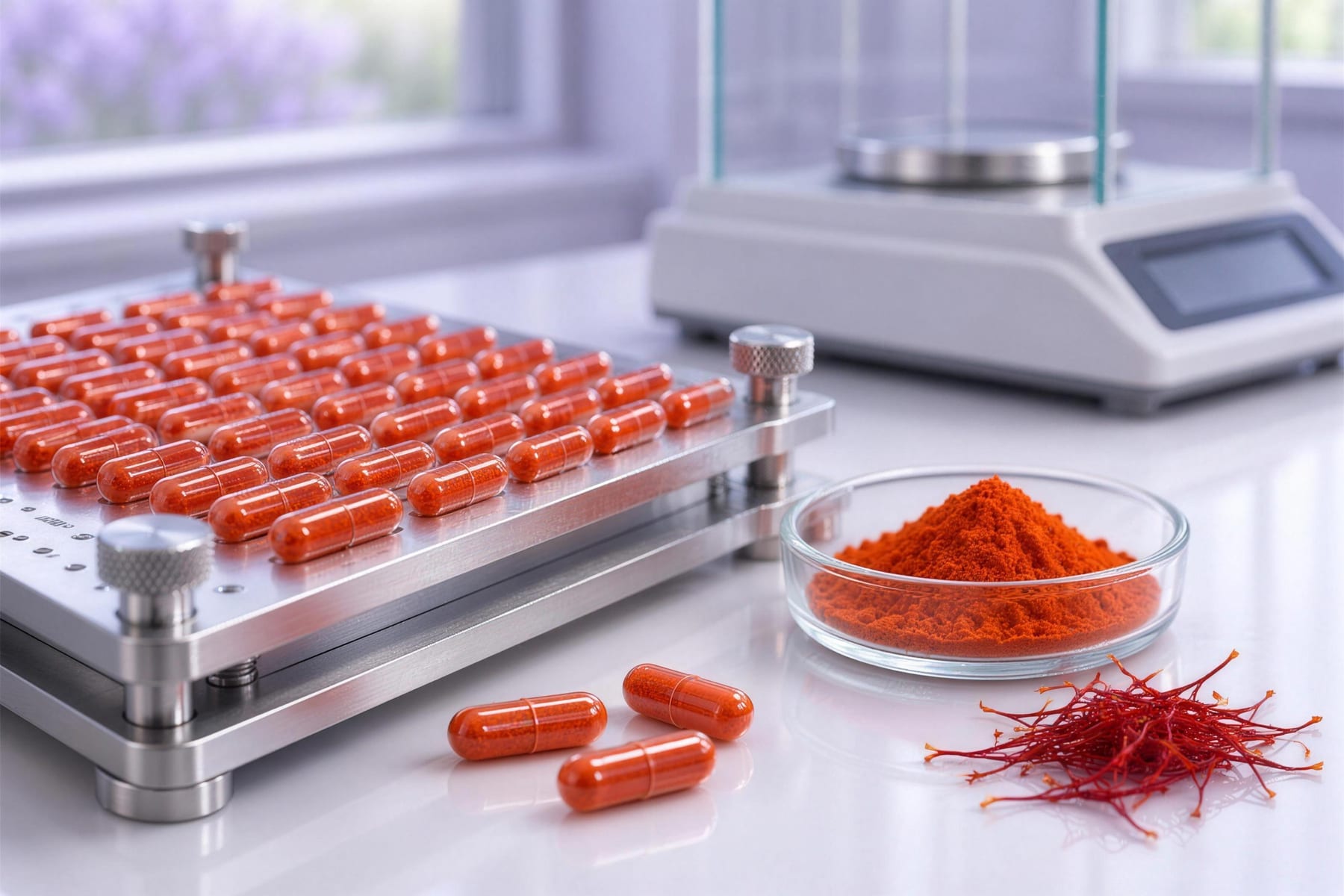
Thirty milligrams a day is the most common dose in saffron research, and it is the serving Saffrion 42™ is designed for: one 30 mg capsule, once daily. Where does that number come from, how have doses varied since, and what does a milligram of saffron extract actually deliver?
Where 30 mg came from
The 30 mg convention goes back to early clinical trials of saffron, run in Iran in the early 2000s in adults with depression. A 2004 trial gave 30 mg a day of a saffron stigma extract, split into three doses, and compared it with an antidepressant; its authors calculated the dose from an earlier animal study. [1] Two trials published in 2005 used the same 30 mg a day, one against placebo [2] and one against an antidepressant. [3]
The dose stuck. A 2013 systematic review noted that all the trials it included used 30 mg a day, and listed the fixed dose as a limitation. [4] A 2018 meta-analysis found that most of its trials, six in all, used 30 mg a day; one used 100 mg. [5]
These were clinical studies in patients. They explain where the number comes from, not what a supplement may claim.
Doses in more recent trials
Later placebo-controlled trials, most of them with standardized extracts, tested doses between 14 and 30 mg a day:
| Study | Daily dose | Duration | What the doses showed |
|---|---|---|---|
| Kell et al., 2017 [6] | 22 mg or 28 mg | 4 weeks | Mood effect at 28 mg; no effect at 22 mg |
| Lopresti et al., 2020 [7] | 28 mg | 28 days | One dose tested |
| Lopresti et al., 2021 [8] | 14 mg or 28 mg | 28 days | Similar sleep results at both doses |
| Pachikian et al., 2021 [9] | 15.5 mg | 6 weeks | One dose tested |
| Schuster et al., 2025 [10] | 20 mg or 30 mg | 4 weeks | Sleep-quality scores improved at both doses; an anxiety and depression score improved at 30 mg only |
| Lopresti et al., 2025 [11] | 28 mg | 12 weeks | One dose tested |
A few trials went higher, such as one that gave 100 mg a day for 12 weeks. [12]
Where trials compared two doses, the picture is mixed: one found an effect only at the higher dose, another found similar results at both. There is no established dose-response curve for saffron extract.
What higher doses showed
Safety data at higher doses come mainly from short studies in healthy volunteers. In a 2008 double-blind study, 30 volunteers took placebo, 200 mg or 400 mg of saffron stigma tablets a day for seven days. The 400 mg dose lowered standing systolic and mean arterial blood pressure, and some blood values shifted slightly; the authors reported the changes as within normal ranges. [13] A 2014 study at 200 and 400 mg a day for seven days found no differences in the coagulation measures it tested. [14] An umbrella review of meta-analyses listed nausea, dry mouth, poor appetite and headache as the side effects most often reported, with no serious adverse reactions. [15]
We are not aware of an upper intake level for saffron extract set by EFSA or by US authorities. In the US, saffron is listed as generally recognised as safe as a spice and natural extractive, and is permitted as a food colour; [16] those listings concern food use, not supplement doses.
Milligrams are not interchangeable
A dose in milligrams only means something for the extract that was tested. Extracts differ in source, solvent, carrier and marker content, so 30 mg of one extract does not deliver the same compounds as 30 mg of another. That is why dose and standardization have to be read together.
The Saffrion 42™ specification sets a minimum for each marker, so a 30 mg serving provides at least:
- 0.90 mg crocins (30 mg × 3.0%)
- 0.36 mg safranal (30 mg × 1.2%)
To see how those minimums are set and checked, read Standardized saffron extract: what dual standardization means.
How Saffrion 42™ is dosed
Saffrion 42™ is designed for 30 mg per capsule, once daily, the dose most widely used in saffron research. It is supplied as an orange-red powder with maltodextrin as carrier, ready for capsules and tablets.
Dose, time to effect and tolerability for Saffrion 42™ itself require dedicated data. A clinical study of the extract is planned, with results expected in Q1 2027.
References
- [1] Akhondzadeh et al., 2004. 30 mg a day compared with imipramine, 6 weeks. PMID 15341662
- [2] Akhondzadeh et al., 2005. 30 mg a day compared with placebo, 6 weeks. PMID 15852492
- [3] Noorbala et al., 2005. 30 mg a day compared with fluoxetine, 6 weeks. PMID 15707766
- [4] Hausenblas et al., 2013. Systematic review. PMID 24299602
- [5] Yang et al., 2018. Meta-analysis. PMID 29849461
- [6] Kell et al., 2017. 22 mg and 28 mg a day in healthy adults, 4 weeks. PMID 28735826
- [7] Lopresti et al., 2020. 28 mg a day, 28 days. PMID 32056539
- [8] Lopresti et al., 2021. 14 mg and 28 mg a day, 28 days. PMID 34438361
- [9] Pachikian et al., 2021. 15.5 mg a day, 6 weeks. PMID 33925432
- [10] Schuster et al., 2025. 20 mg and 30 mg a day, 4 weeks. PMID 40698027
- [11] Lopresti et al., 2025. 28 mg a day, 12 weeks. PMID 40414301
- [12] Mazidi et al., 2016. 100 mg a day, 12 weeks. PMID 27101556
- [13] Modaghegh et al., 2008. 200 mg and 400 mg a day in healthy volunteers, 7 days. PMID 18693099
- [14] Ayatollahi et al., 2014. 200 mg and 400 mg a day, coagulation, 7 days. PMID 23733488
- [15] Lu et al., 2021. Umbrella review of meta-analyses. PMID 34419735
- [16] US Code of Federal Regulations, 21 CFR 182.10 (spices and natural flavourings). eCFR
Statements have not been evaluated by regulatory authorities. Professional content for product development, for B2B use only.