Saffron extract for sleep: what the research shows
What placebo-controlled trials of saffron extracts report on sleep, the doses and measures they used, and what the results do and don’t support.
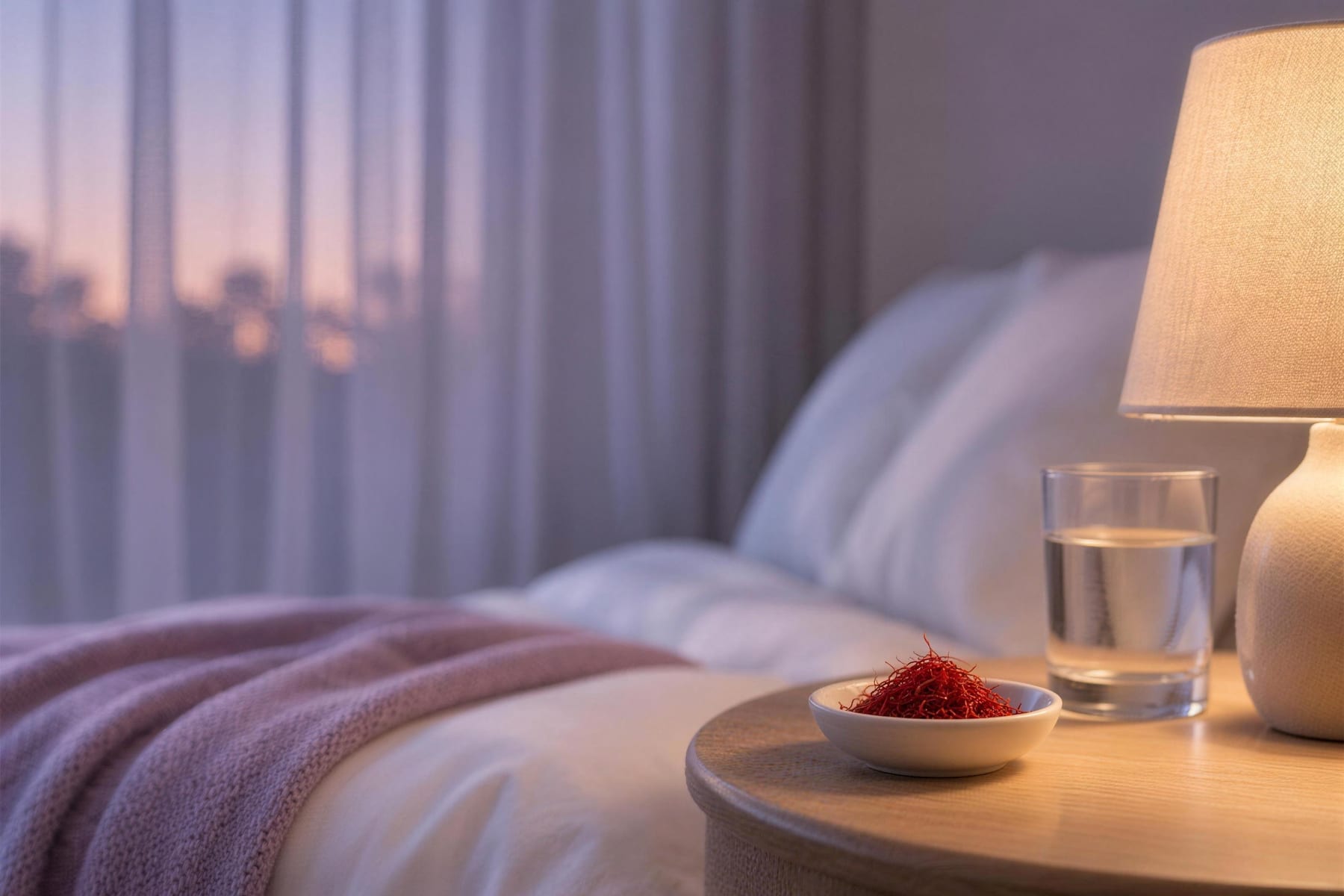
Sleep is one of the most studied areas in saffron research, and one of the categories in which supplement brands position saffron. Since 2020, several placebo-controlled trials have tested saffron extracts in adults with poor sleep, and meta-analyses have started to pool the results.
None of these trials used Saffrion 42™. They describe the category, not this extract. Here is what they tested, what they found, and where their conclusions stop.
The trials at a glance
| Study | Participants | Daily dose | Duration | What it reported |
|---|---|---|---|---|
| Lopresti et al., 2020 [1] | 63 adults with self-reported sleep problems (55 analysed) | 28 mg (14 mg twice daily) | 28 days | Greater improvement than placebo in insomnia severity, restorative sleep and sleep-diary quality |
| Lopresti et al., 2021 [2] | 120 adults with unsatisfactory sleep | 14 mg or 28 mg, 1 hour before bed | 28 days | Better than placebo on sleep-quality ratings, mood on waking and insomnia symptoms; no difference on other measures; similar results at both doses |
| Pachikian et al., 2021 [3] | 66 adults with mild-to-moderate sleep disorder linked to anxiety | 15.5 mg | 6 weeks | Improvements in the saffron group on actigraphy and sleep questionnaires, reported as changes within the group |
| Schuster et al., 2025 [4] | 165 adults with moderate insomnia | 20 mg or 30 mg | 4 weeks | Greater reduction than placebo on the primary insomnia scale, with better sleep quality and lower perceived stress; several other measures showed no difference |
| Lang et al., 2025 [5] | 52 adults aged 55 to 85 with sleep complaints (pilot study) | 30 mg | 4 weeks | Better subjective sleep quality and sleep efficiency, and shorter sleep-onset latency on an EEG sleep tracker |
What the trials have in common
The trials enrolled adults reporting poor sleep or insomnia symptoms. Doses ranged from 14 to 30 mg of extract a day, and treatment lasted four to six weeks. Most outcomes were questionnaires, such as the Insomnia Severity Index, the Athens Insomnia Scale, the Pittsburgh Sleep Quality Index and sleep diaries; two studies added actigraphy or a sleep tracker.
Where the abstracts report tolerability, adverse events were few: no reported adverse effects in the 2020 trial, no significant adverse effects in the 2021 trial, and no serious adverse events in the 2025 insomnia trial.
What the reviews say
Two meta-analyses published in 2022 pooled the earlier trials:
- Lian et al., 2022 pooled randomised trials in healthy adults and several patient groups. Saffron improved scores on the Pittsburgh Sleep Quality Index and the Insomnia Severity Index compared with placebo, with no serious adverse events reported. [6]
- Munirah et al., 2022 pooled eight studies. The effect on sleep quality was statistically significant but rested on evidence rated very low quality; the effect on insomnia severity was not significant. [7]
Both reviews pre-date the 2025 trials. The studies they pooled were small and short, and used different extracts and doses.
How to read these results
- The extract matters. The trials used several different saffron extracts, made and standardized in different ways. A result obtained with one extract does not transfer to another.
- Not every measure moved. Several trials found differences on their primary outcome but not on many secondary ones. A fair summary reports both.
- Some results are within-group. One abstract reports changes in the saffron group only, without a comparison with placebo. That is weaker evidence than a difference between groups.
- Durations were short. Four to six weeks says little about longer use.
- Sleep effects did not appear in every trial. In a 12-week mood trial at 28 mg a day, sleep scales showed no difference from placebo overall; only an exploratory subgroup with worse sleep improved. [8]
- Funding. Several trials were funded by, or co-authored with, the companies that make the extracts tested.
For the doses used across saffron research, see Saffron extract dosage: where 30 mg a day comes from.
What this means for product development
Sleep support is one of the categories Saffrion 42™ is offered for, as an ingredient in evening relaxation and wind-down formulas. The published trials explain why the category exists; they are not evidence for Saffrion 42™ itself. A dedicated clinical study of Saffrion 42™ is planned, with results expected in Q1 2027.
On its own, this research does not support a claim on a finished product. In 2021, EFSA concluded that the evidence submitted for one saffron extract and positive mood was insufficient to establish a cause-and-effect relationship. [9] Your regulatory team will know what applies in each market where you sell.
References
- [1] Lopresti et al., 2020. Sleep quality in adults with self-reported sleep problems, 28 days. PMID 32056539
- [2] Lopresti et al., 2021. Two doses and sleep quality in adults with unsatisfactory sleep, 28 days. PMID 34438361
- [3] Pachikian et al., 2021. Sleep in adults with a sleep disorder linked to anxiety, 6 weeks. PMID 33925432
- [4] Schuster et al., 2025. Two doses in adults with moderate insomnia, 4 weeks. PMID 40698027
- [5] Lang et al., 2025. Pilot study in older adults with sleep complaints, 4 weeks. PMID 40762630
- [6] Lian et al., 2022. Systematic review and meta-analysis, saffron and sleep. PMID 35325766
- [7] Munirah et al., 2022. Systematic review and meta-analysis, saffron and sleep. PMID 36141931
- [8] Lopresti et al., 2025. Mood in adults with subclinical depressive symptoms, 12 weeks. PMID 40414301
- [9] EFSA NDA Panel, 2021. Scientific opinion on a saffron extract and positive mood. PMID 34249157
Statements have not been evaluated by regulatory authorities. Professional content for product development, for B2B use only.